
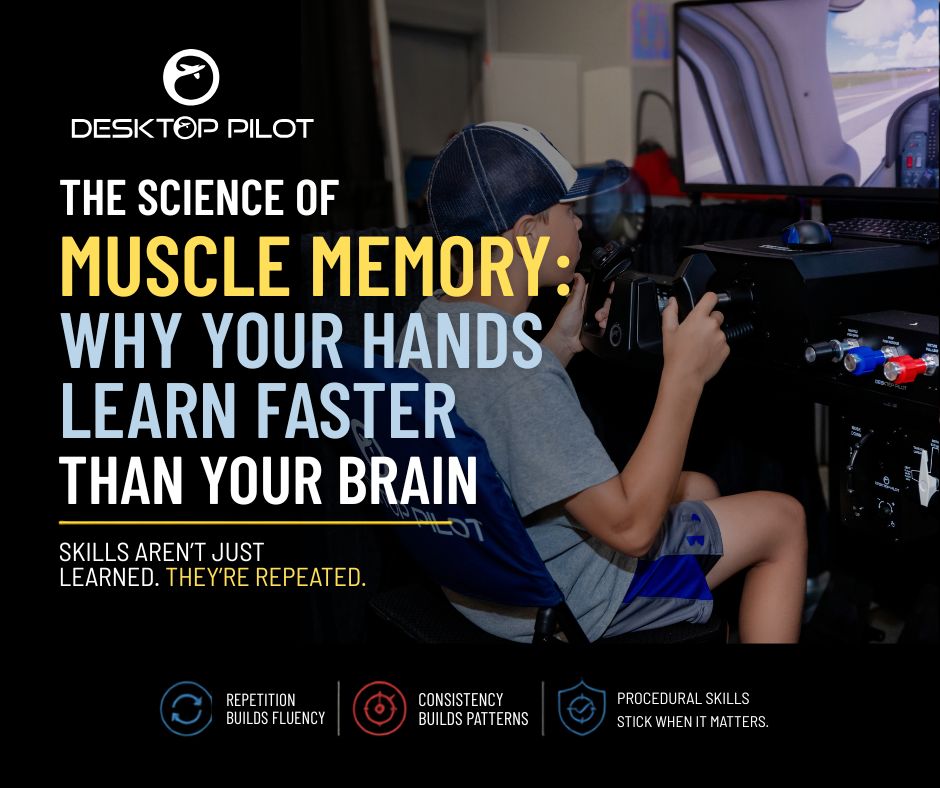
The Science of Muscle Memory: Why Your Hands Learn Faster Than Your Brain
Ask a working pilot how they know exactly where the flap lever is without looking, and most will struggle to explain it. They just know. That kind of knowledge lives somewhere other than conscious thought, and understanding where it comes from explains why simulator repetition works so well, and why cramming ground school material the night before a checkride so often does not.
Two Different Kinds of Memory
Cognitive scientists generally separate memory into two broad categories. Declarative memory holds facts and knowledge you can consciously describe: airspace classifications, weight and balance formulas, the definition of density altitude. Procedural memory holds skills your body performs without needing to narrate them: a scan pattern across the instrument panel, a stabilized approach configuration, the sequence of a go around.
Declarative memory is fast to acquire and fast to fade. You can memorize a regulation the night before a written exam and forget most of it within weeks. Procedural memory is slow to build and remarkably durable once it forms. Pilots who have not flown in years can often still run a checklist flow or configure an approach with very little hesitation, because that knowledge was encoded differently.
Why Repetition Beats Explanation
This is why an instructor explaining a maneuver once rarely produces a pilot who can perform it smoothly. Procedural memory forms through repeated, consistent practice, not through understanding alone. The brain builds a kind of physical shorthand for a task only after the body has performed it enough times in a stable pattern.
That is also why inconsistent practice, a different aircraft every lesson, a different panel layout, a long gap between sessions, slows this process down. The nervous system is trying to build a reliable pattern, and every variation resets part of that work.
What This Means for Simulator Training
A home simulator’s real value is not realism for its own sake. It is the ability to produce the exact kind of consistent, high frequency repetition that procedural memory depends on. Running the same instrument scan, the same emergency checklist, or the same approach configuration dozens of times in a stable, low cost environment is precisely the condition under which procedural learning consolidates.
This does not replace the judgment, feel, and situational awareness that only real flight can build. But it front loads the mechanical fluency so that time in the aircraft can be spent on those higher order skills instead of on relearning where the flap lever is.
Desktop Pilot hardware is built for exactly this kind of repetition, consistent, precise, and available whenever you have twenty minutes to spare. Explore our full simulator lineup to start building the fluency that sticks.