
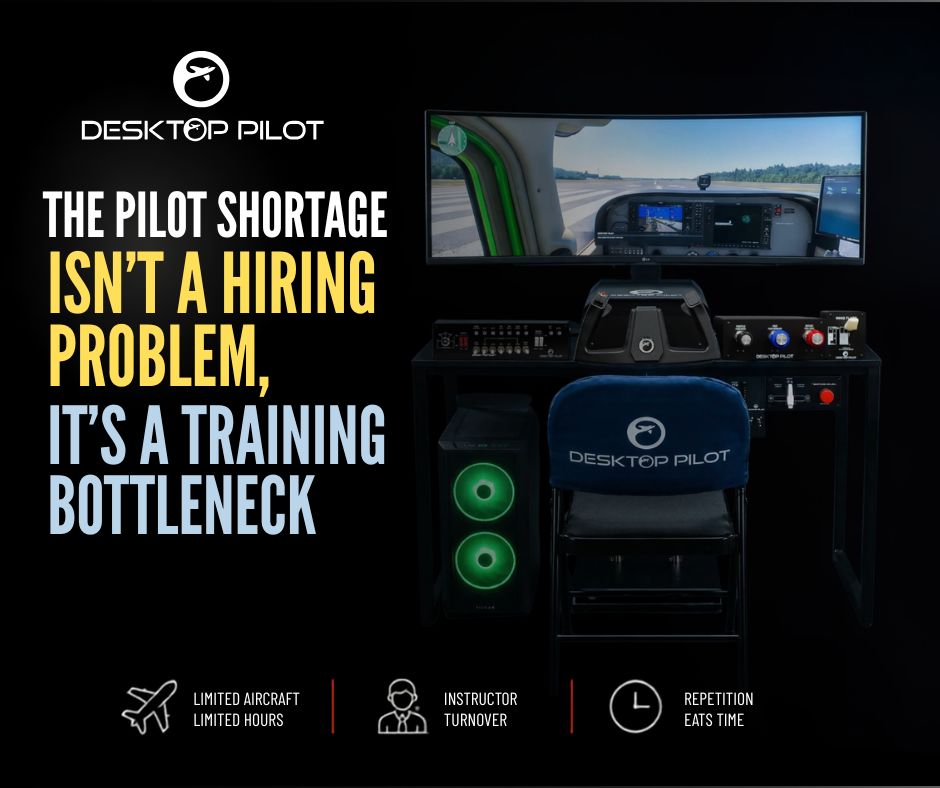
The Pilot Shortage Isn’t a Hiring Problem, It’s a Training Bottleneck
Every few months, another headline warns of a looming pilot shortage. Airlines are recruiting harder, offering signing bonuses, and lowering age minimums for regional carriers. The framing is almost always the same: not enough people want to fly for a living. That framing is wrong, or at least incomplete. The harder truth is that the industry has plenty of interested candidates and not nearly enough capacity to train them.
The Bottleneck Is Capacity, Not Interest
Ask any flight school director what limits their growth and the answer rarely involves student demand. It involves aircraft availability, instructor turnover, and scheduling. A single-engine trainer can only fly so many hours a day before maintenance catches up with it. A certificated flight instructor can only supervise one student at a time, and most instructors move on to airline jobs within a few years of getting rated themselves. The pipeline isn’t short on people who want in. It’s short on the physical and human infrastructure needed to move them through.
That distinction matters because it points to a different solution than the one usually proposed. Raising pilot salaries or running recruitment campaigns addresses interest, which was never the constraint. Expanding training capacity addresses the actual bottleneck.
Where the Hours Actually Go
A meaningful share of early flight training time isn’t spent building judgment or airmanship. It’s spent on repeatable mechanics: checklist flows, radio phraseology, instrument scans, traffic pattern procedures. These are essential skills, but they don’t require an aircraft burning fuel on the ramp to practice. They require repetition, and repetition is exactly what expensive aircraft time is worst suited to provide affordably.
When a student spends their first several hours of engine time relearning a checklist flow they could have drilled on the ground, that’s aircraft capacity spent on something a simulator handles just as well, at a fraction of the cost and with zero maintenance downtime.
Simulation as a Capacity Release Valve
A meaningful share of early flight training time isn’t spent building judgment or airmanship. It’s spent on repeatable mechanics: checklist flows, radio phraseology, instrument scans, traffic pattern procedures. These are essential skills, but they don’t require an aircraft burning fuel on the ramp to practice. They require repetition, and repetition is exactly what expensive aircraft time is worst suited to provide affordably.
When a student spends their first several hours of engine time relearning a checklist flow they could have drilled on the ground, that’s aircraft capacity spent on something a simulator handles just as well, at a fraction of the cost and with zero maintenance downtime.
Rethinking the Shortage
The pilot shortage will not be solved by convincing more people that flying is a good career. Most already believe that. It will be solved by expanding the throughput of the training system itself, and simulation is one of the few levers that scales without needing another airplane on the ramp or another instructor in the pattern.
Desktop Pilot builds simulator hardware designed to handle the repetition that used to require engine time. If you’re a flight school, instructor, or student pilot looking to protect your aircraft hours for what matters most, our training bundles are built for exactly that.