
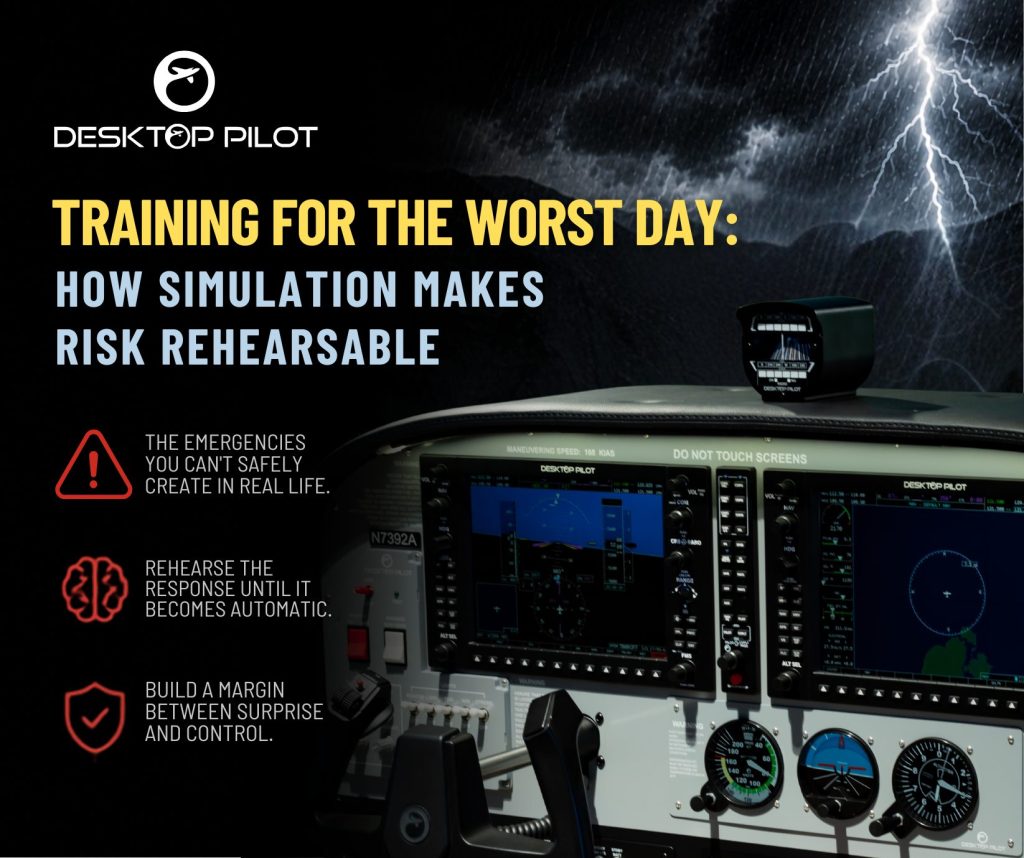
Training for the Worst Day: How Simulation Makes Risk Rehearsable
Most flight hours are, by design, uneventful. A student practices a normal pattern, a stabilized approach, a routine cross country. That is exactly how it should be. But aviation safety has always depended on preparing for the day that is not routine: the engine roughness at altitude, the sudden weather deterioration, the instrument failure at the worst possible moment. The problem is that these are precisely the scenarios you cannot safely or ethically create at will in a real aircraft.
The Cost of Practicing the Worst Case
Emergency procedures training in a real aircraft is necessarily limited. An instructor can pull the throttle to simulate an engine failure, but cannot actually fail the engine. A student can practice partial panel flying, but the failure is simulated, not real, and the exercise carries genuine risk simply by nature of operating an aircraft at all. There are entire categories of emergencies, a real electrical fire, a genuine control surface malfunction, that responsible instruction will never attempt to recreate in the air.
That leaves a gap between the procedures a pilot has memorized and the procedures a pilot has actually rehearsed under realistic pressure. Memorizing a checklist and executing it while genuinely startled are not the same skill.
Rehearsal Without the Risk
Simulation closes that gap by making the worst case scenario something a pilot can rehearse as many times as needed, with zero physical risk and no aircraft damage on the line. An unexpected instrument failure, a sudden IMC encounter, an engine out over unfamiliar terrain, all of these can be run repeatedly, varied in timing and severity, until the response becomes close to automatic.
This matters because the research on human performance under stress is consistent: people default to their most rehearsed response when startled, not their best theoretical understanding of the correct one. A pilot who has only read about an emergency procedure is relying on declarative knowledge under pressure, which tends to degrade badly. A pilot who has rehearsed the response dozens of times in a simulator is relying on something closer to trained instinct.
Building a Margin, Not Just a Checklist
The goal of this kind of training is not to eliminate risk from flying, which is impossible, but to build a margin between a surprising situation and a controlled response. Every rehearsal in a low stakes environment shrinks the gap between what a pilot knows and what a pilot can actually execute when startled.
That margin is what separates a routine but serious situation from an accident report. It is built well before the moment it is needed, and it is built through repetition that a real aircraft simply cannot provide safely or affordably.
Desktop Pilot’s instrument and switch panel hardware is designed to make emergency procedure rehearsal realistic and repeatable. Browse our instrument panels and switch modules to start building that margin.