
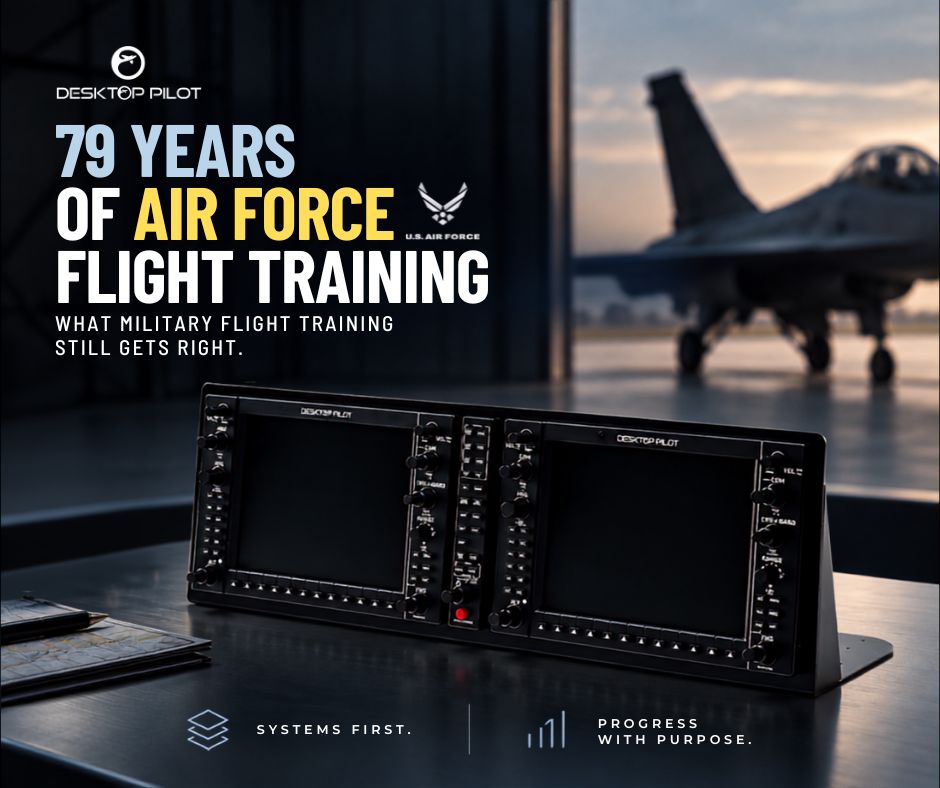
79 Years of the U.S. Air Force: What Military Flight Training Still Gets Right
On September 18, 1947, the U.S. Air Force became its own branch of the military, separating from the Army Air Forces that had carried American airpower through the Second World War. Seventy-nine years later, the anniversary is a good excuse to ask a practical question instead of just a ceremonial one: what does military flight training actually do differently, and how much of it applies to someone learning to fly today, whether in a real cockpit or at a desk.
Systems Before Stick and Rudder
Military flight training does not start with takeoffs and landings. It starts with systems. A student pilot in a military program will know the electrical architecture, the fuel system, and the avionics logic of their aircraft cold, often before they have logged meaningful stick time. The reasoning is simple: you cannot manage an emergency in a system you do not understand, and you cannot fly efficiently in an aircraft whose logic is still a mystery to you.
Civilian training, especially at the private pilot level, tends to compress this. Systems knowledge gets folded into ground school lectures and multiple-choice questions rather than treated as a skill in its own right. That gap shows up later, usually during an unfamiliar avionics failure or an unexpected system indication that a pilot has read about but never actually worked through.
This is exactly the gap a modern glass cockpit trainer is built to close. Spending real time with a G1000 Suite, not glancing at a diagram in a textbook, but actually navigating its pages, understanding its failure modes, and building the same muscle memory a military systems course demands, changes how a pilot responds when something on the panel does not look right.
Structured Progression, Not Random Repetition
The other thing military training gets right is sequencing. Nothing is practiced in isolation, and nothing is repeated just for the sake of repetition. Each phase builds a specific, testable competency before the next phase adds complexity on top of it. It is the opposite of a student practicing whatever maneuver they feel like on a given day.
That same principle is why a structured hardware setup, built in phases rather than assembled piecemeal, tends to produce better outcomes than a randomly assembled collection of gear. A pilot who works through a properly sequenced training bundle, controls first, then systems, then full mission profiles, is following the same logic the military has used for decades, just scaled down to a home training environment.
The Anniversary is a Reminder, Not Just a Celebration
It would be easy to treat September 18 as a one-day tribute and move on. The more useful way to mark it is to ask whether your own training approach reflects the discipline the anniversary represents. Systems mastery before stick time. Structured progression instead of random practice. Those principles did not stay in 1947, and they still separate pilots who are truly prepared from pilots who are simply current.
That is not a military-only standard. It is available to anyone willing to train the same way.