
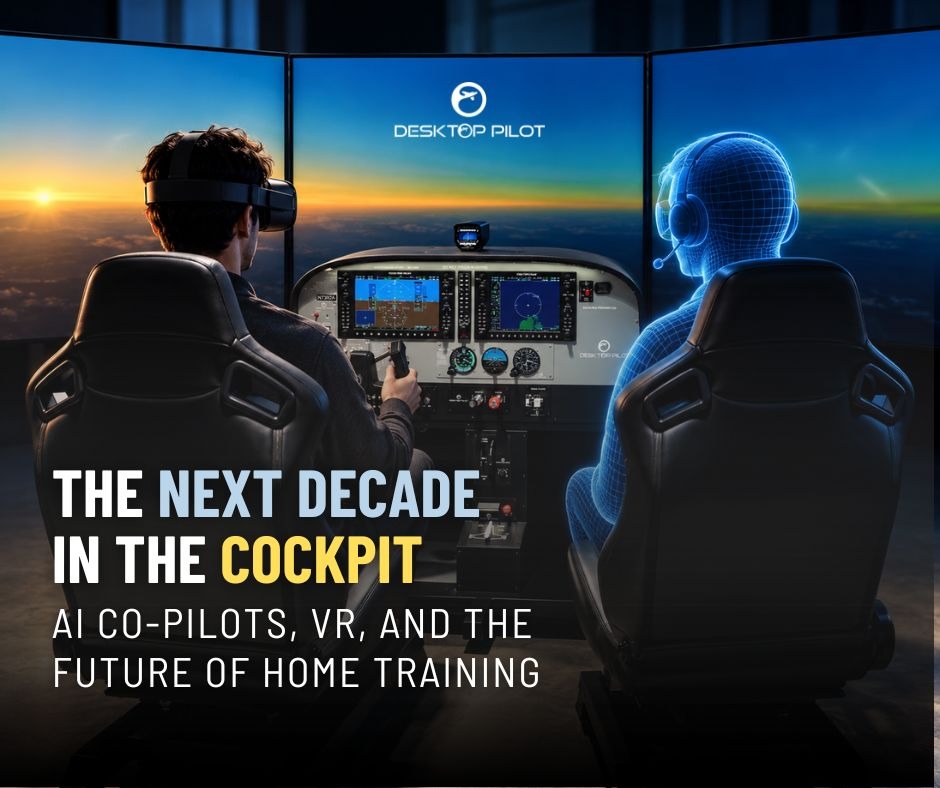
The Next Decade in the Cockpit: AI Co-Pilots, VR, and the Future of Home Training
Home flight simulation has already changed how people learn to fly, moving procedural fluency out of expensive aircraft hours and onto a desk. The next decade is likely to change something different: who or what sits in the seat next to you while you practice, and how immersive the environment around you becomes. Neither shift is science fiction anymore. Both are already visible in early form.
AI as a Training Partner
The most immediate change is the rise of AI systems that can act as a responsive training partner rather than a static piece of software. Instead of a fixed scenario that plays out the same way every time, an AI driven simulation can adjust difficulty based on how a student is actually performing, introduce a realistic weather deterioration at the moment it will teach the most, or simulate an air traffic controller responding naturally to a student’s radio calls instead of following a scripted line.
This matters because one of the limitations of traditional simulation has always been its predictability. A student who has flown the same practice scenario ten times starts anticipating it rather than reacting to it. A system that varies its behavior intelligently, based on the specific student in front of it, keeps training closer to the unpredictability of real flight.
Virtual Reality and the Visual Gap
Traditional monitor based simulation has always had one honest limitation: depth perception and peripheral awareness never fully match a real cockpit, no matter how many screens surround a pilot. Consumer VR headsets have improved enormously in resolution and field of view, closing that gap faster than most people expected even a few years ago. A pilot practicing traffic pattern scanning or a visual approach in VR is training the actual visual habits that transfer to a real cockpit, not just the procedural ones.
This does not replace physical hardware. A yoke, throttle, and pedals still need to be real, tactile objects for control feel to transfer properly. What VR adds is the visual environment those physical controls sit inside, closing one of the last remaining gaps between simulated and real flight.
What Stays the Same
Neither AI nor VR changes the underlying principle that has driven every idea in this series: procedural fluency, built through repetition in a low stakes environment, protects the value of real flight time. These technologies simply make that repetition more realistic, more responsive, and closer to the unpredictability of an actual cockpit.
The tools available to the next generation of aviators will keep changing. What a student pilot actually needs from them will not. Preparation, repeated until it becomes instinct, remains the throughline from Amelia Earhart’s era to this one, and whatever comes after it.
Desktop Pilot is committed to building hardware that keeps pace with where training technology is headed, without losing sight of the fundamentals that make it work. Explore our current lineup and stay with us as we bring what’s next to your desk.