
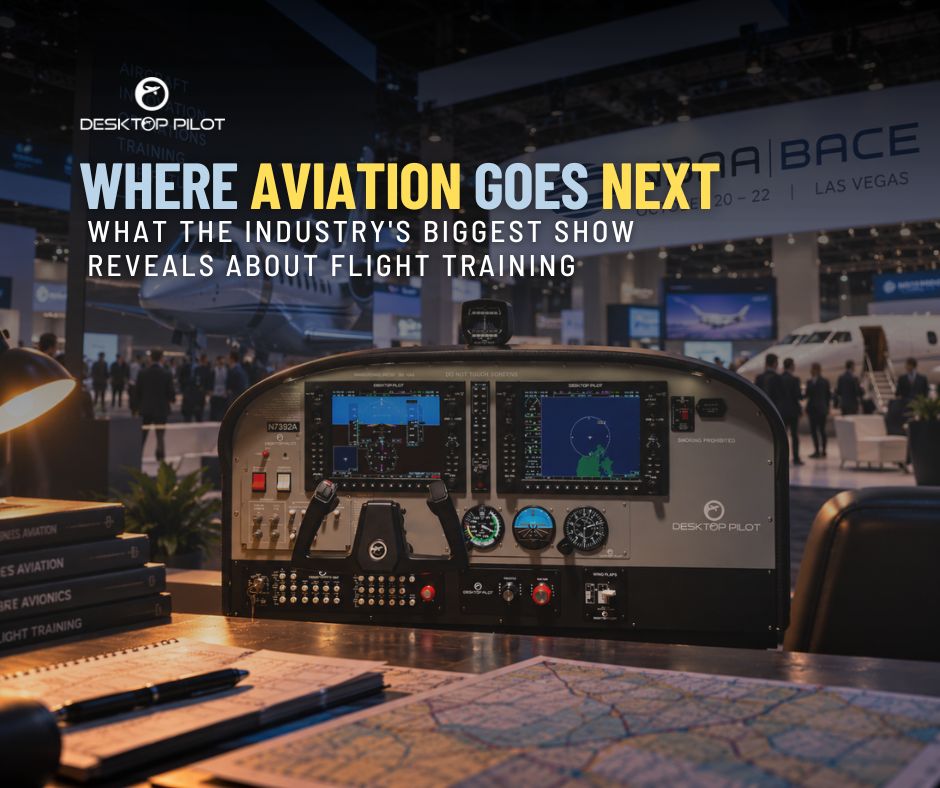
What Business Aviation’s Biggest Show Reveals About Where Flight Training Is Headed
The NBAA Business Aviation Convention and Exhibition, known throughout the industry as NBAA-BACE, lands in Las Vegas from October 20 to 22 this year. It is the largest gathering in business aviation, drawing tens of thousands of attendees, every major aircraft manufacturer, and the operators and training providers who keep that fleet flying. It is also, whether or not most attendees would frame it this way, a very reliable preview of where flight training technology is headed next.
The Glass Cockpit Is No Longer the Exception
A decade or two ago, walking the floor of a show like this meant seeing glass cockpit avionics primarily in the newest and most expensive aircraft on display, a forward-looking feature rather than a baseline expectation. That is no longer true. Integrated glass panel systems are now the standard across nearly the entire spectrum of aircraft NBAA-BACE represents, from entry-level piston singles up through the business jets the show is best known for.
That shift matters beyond the show floor. It means the systems knowledge that used to be a specialized skill for pilots moving into more advanced aircraft is now baseline competency expected of nearly anyone flying anything built in the last fifteen years. A student training today without real glass panel proficiency is training for an aircraft category that is quietly disappearing.
What the Show Signals for Everyday Pilots
Most of what gets announced at NBAA-BACE will never directly touch a typical general aviation pilot’s flying. But the direction it signals almost always does, eventually. Avionics technology tends to move from business aviation and trickle down into general aviation over a handful of years, the same way glass panels themselves did. Paying attention to where the technology is headed at the top of the market is a reasonable way to anticipate what will matter at every level underneath it.
That is exactly why building real proficiency on a G1000 Suite now is not just about the aircraft a pilot flies today. It is about staying ahead of where the entire category of aircraft is heading, rather than catching up to it later.
Training for Where the Industry Is Going, Not Where It Has Been
A show like NBAA-BACE is ultimately a preview of the next several years of aviation, playing out three days at a time in Las Vegas. The pilots who benefit most from paying attention to it are not necessarily the ones attending in person. They are the ones training, on a full flight simulator or otherwise, for the direction the industry is visibly headed rather than the aircraft category that used to be standard.
The show floor changes every year. The trend line underneath it has been remarkably consistent: more integration, more glass, less room for pilots who never built real proficiency with it.