
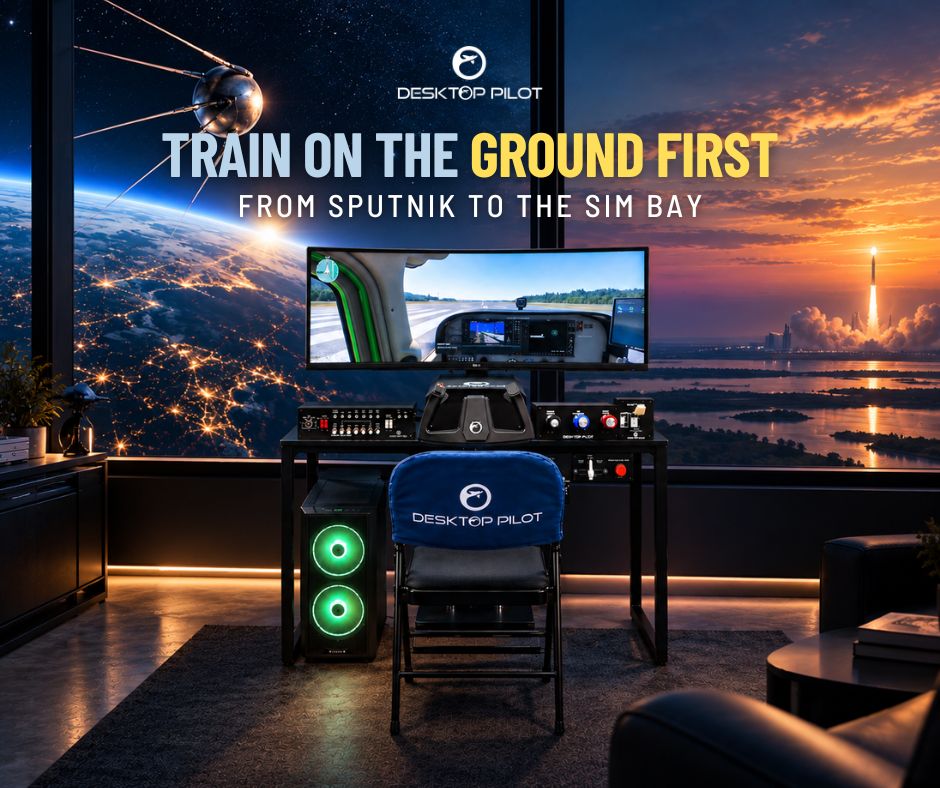
From Sputnik to the Sim Bay: What World Space Week Gets Right About Training on the Ground First
World Space Week runs from October 4 to 10 every year, marking the anniversary of Sputnik’s launch in 1957 and the start of the space age. It is easy to file this under space trivia and move on. But there is a training philosophy buried in the history of every space program since Sputnik that applies directly to anyone learning to fly, and it is worth pulling out on purpose.
Simulation Was Never the Backup Plan
From the earliest days of human spaceflight, simulation was not a nice-to-have supplement to real training. It was the primary training method. Mercury astronauts spent far more hours in procedure trainers and simulators than they ever spent in an actual spacecraft before their first flight, for a simple reason: spacecraft time was scarce, expensive, and unforgiving of mistakes, while simulator time was neither.
That same logic has only gotten stronger over the decades. Modern astronaut candidates train on high-fidelity simulators for years before ever approaching a real vehicle, rehearsing nominal procedures and failure scenarios alike until the response is close to automatic. NASA did not adopt this approach because it was convenient. It adopted it because real vehicle time could not, by itself, produce the level of readiness the mission demanded.
The Same Math Applies at Smaller Scale
General aviation operates under a smaller, less dramatic version of the exact same constraint. Aircraft rental and instructor time are expensive and limited. A student who spends that scarce time relearning procedures they could have drilled elsewhere is making the same inefficient trade an early space program would have made by skipping the simulator and going straight to flight hardware.
A serious full flight simulator setup applies that same principle at home. Procedures, checklists, and failure scenarios get rehearsed until they are automatic, in an environment where getting something wrong costs nothing but a restart. That is not a lesser form of training. It is the same philosophy that has quietly underwritten every successful human spaceflight program for over 60 years.
Building the Habit in Stages
Just as astronaut training does not throw a candidate into a full mission simulation on day one, effective home training works best built in stages, starting with a properly sequenced training bundle rather than jumping straight to the most complex scenario available. Fundamentals first, complexity added deliberately, exactly the structure that has defined serious simulation-based training since Sputnik first went up.
A Week Worth Noticing
World Space Week is not really about space hardware. It is about a training philosophy that turned out to be right: rehearse it on the ground first, as many times as it takes, so the real thing goes the way it is supposed to. That principle did not stay in orbit. It is sitting on desks in home cockpits right now.