
What Flight Schools Are Learning From Simulation Data
For most of flight training’s history, an instructor’s assessment of a student’s progress came down to memory and intuition. How did the last approach look compared to the one before it. Was the radio call smoother this time. Those judgments are valuable, but they are also subjective, and they fade the same way any memory does. Simulation is quietly changing that, not by replacing the instructor’s judgment, but by giving it something to compare against.
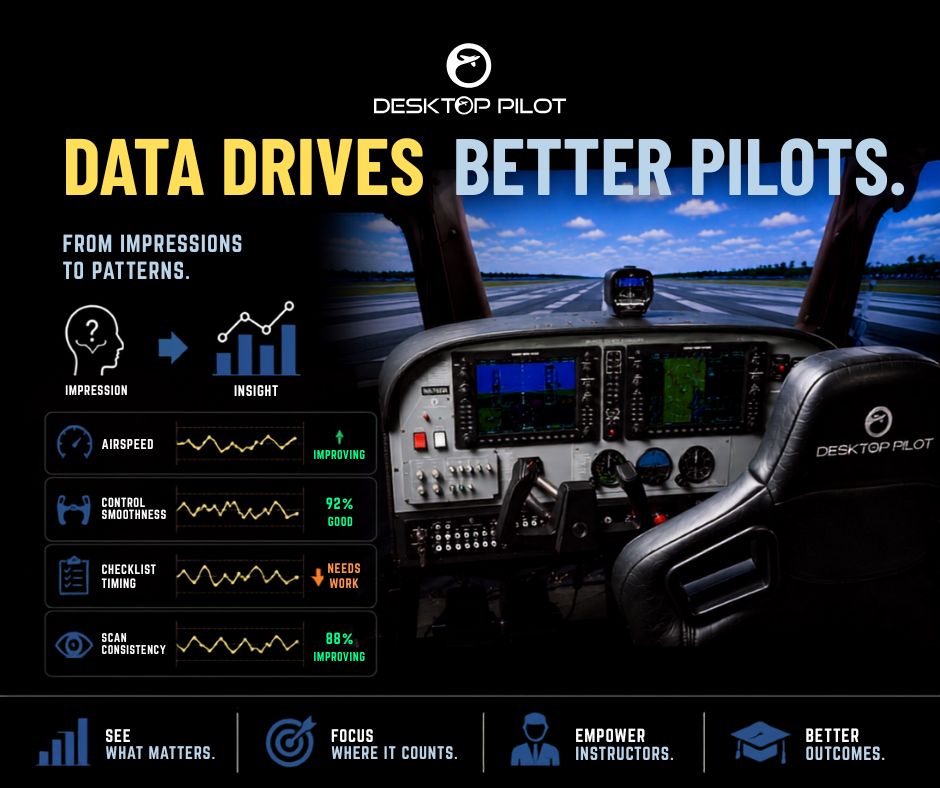
From Impressions to Patterns
A simulator session can log far more than a human instructor can track in real time: airspeed deviation across an approach, control input smoothness, checklist timing, scan pattern consistency. On its own, one session of data is not particularly useful. Across dozens of sessions, patterns start to appear that a single lesson would never reveal. A student’s instrument scan might be improving steadily except during a specific phase of flight, which is a far more precise finding than a general sense that someone needs more instrument practice.
This shifts feedback from a broad impression to a specific, addressable pattern. Instead of telling a student to work on approaches in general, an instructor can point to exactly where the deviation happens and why.
Individualized Training, at Scale
Every student learns at a different pace and struggles with different specific elements of flying. A traditional syllabus, built around fixed hour blocks, was never designed to adapt to that variation, mostly because there was no efficient way to detect it. Data from repeated simulator sessions makes it possible to see where an individual student is actually stuck, rather than assuming everyone needs the same amount of repetition on the same maneuver.
Some flight schools are beginning to use this kind of data to adjust syllabus pacing in real time, moving a student forward faster where they show consistent competence and slowing down precisely where the data shows a pattern of struggle. That is a meaningfully different model than a fixed number of hours per maneuver, and it tends to produce more consistent outcomes with less wasted time.
What This Means for Instructors
None of this replaces the instructor’s role. If anything, it sharpens it. An instructor freed from having to reconstruct a student’s history from memory can spend more of a lesson on judgment, decision making, and the kind of coaching that data cannot generate on its own. The data tells you where to look. It does not replace the person doing the looking.
Desktop Pilot hardware pairs with modern simulation software to make this kind of session tracking accessible to individual pilots and small flight schools alike. Explore our full lineup to see how a data informed approach could fit your training.